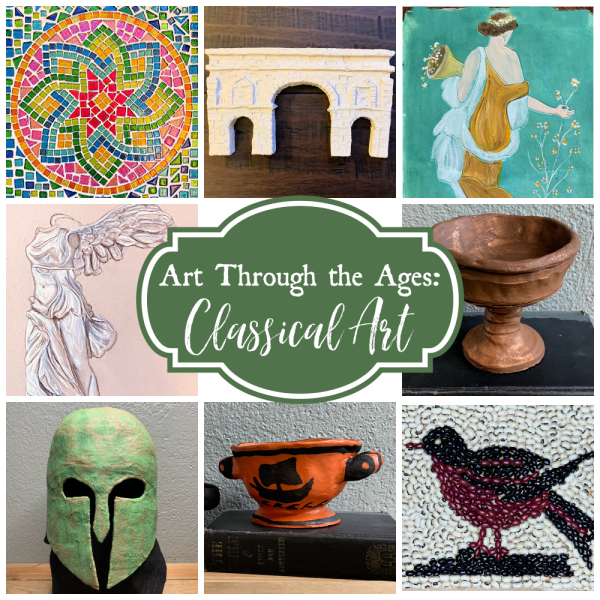
When people talk about Classical Art, they usually mean the art and architecture of:
- Ancient Greece
- the Etruscans
- Ancient Rome
These cultures shaped some of the most influential artistic ideas in Western history.
Greek artists studied the human body, proportion, balance, movement, ideal beauty, etc.
Etruscan artists created lively tomb paintings, sculptures, decorative objects.
Roman artists absorbed ideas from both Greece and Etruria, then developed new traditions in:
- portraiture
- architecture
- engineering
- mosaics
- frescoes
The Classical world influenced artists for centuries.
You can still see its legacy in:
- Renaissance painting
- Neoclassical architecture
- government buildings
- sculpture
- columns and domes
- ideas about proportion and beauty
In this guide, we’ll explore the characteristics of Classical Art, famous Greek, Etruscan, and Roman artworks, architecture, sculpture, painting, and picture study ideas for children and students.
What Is Classical Art?
Classical Art generally refers to the artistic traditions of Ancient Greece and Rome, along with the Etruscan civilization that developed in Italy before Rome became dominant.
For this art-history sequence, Classical Art follows our study of:
- Prehistoric Art
- Mesopotamian Art
- Ancient Egyptian Art
and leads eventually toward:
- Early Christian Art
- Byzantine Art
- Medieval Art
- Renaissance Art
The Classical world marks an important shift in art history.
Artists became increasingly interested in:
- anatomy
- proportion
- naturalistic movement
- idealized human figures
- architectural order
But Classical Art was not one single style.
Greek, Etruscan, and Roman artists each developed their own visual traditions.
When Was Classical Art?
For a simplified timeline, Classical Art can be placed approximately between 490 BC and AD 476. But its roots begin earlier. A broader timeline looks like this:
Archaic Greece (approximately 700–480 BC)
Classical Greece (approximately 480–323 BC)
Hellenistic Greece (323–31 BC)
Etruscan Civilization (approximately 8th–3rd centuries BC)
Roman Republic (509–27 BC)
Roman Empire (27 BC–AD 476 in the West)
These dates overlap because Greek, Etruscan, and Roman cultures interacted with one another.
Ancient Greek Art
Ancient Greek artists had an enormous influence on later European art.
They explored how to represent the human body with increasing:
- accuracy
- movement
- balance
- idealization
Greek artists also developed architectural systems based on:
- proportion
- symmetry
- mathematical relationships
Their art often centered on:
- gods and goddesses
- heroes
- athletes
- mythology
- civic life
The Greek Ideal
Greek artists were deeply interested in the human figure.
Rather than simply copying one individual body, Classical Greek sculptors often sought an ideal.
They studied:
- anatomy
- proportion
- balance
- movement
and created figures intended to represent physical harmony.
This idealized approach became one of the most influential ideas in Western art history.
Archaic Greek Sculpture
Earlier Greek statues often appear:
- stiff
- frontal
- symmetrical
Male figures called kouroi and female figures called korai often stand upright with:
- arms near the body
- one foot slightly forward
- a formal smile
This expression is sometimes called the:
Archaic smile
These sculptures are useful because students can compare them with later Classical statues and immediately see how Greek sculpture changed.
Classical Greek Sculpture
During the Classical period, Greek artists became much more interested in natural movement.
Figures begin to:
- shift their weight
- bend
- turn
- appear relaxed
One important development was contrapposto.
Contrapposto is a standing pose in which most of the body’s weight rests on one leg.
This causes the:
- hips
- shoulders
- torso
to shift naturally.
The body feels alive rather than rigid.
Contrapposto
To understand contrapposto, stand with your weight evenly on both feet.
Your body will feel:
- balanced
- symmetrical
- stiff
Now shift most of your weight onto one leg.
Immediately:
- one hip rises
- the other drops
- your shoulders adjust
- your body curves slightly
That natural shift is what Greek sculptors began capturing.
Contrapposto became enormously important in later art, especially during the Renaissance.
Polykleitos and Ideal Proportion
Greek sculptor Polykleitos became famous for exploring ideal human proportions.
His sculpture known as the Doryphoros, or Spear Bearer, demonstrates:
- contrapposto
- balance
- anatomical study
- proportion
Polykleitos also wrote about artistic proportion in a work traditionally called the Canon.
The original sculpture is lost, but Roman copies preserve its design.
This is an important reminder:
Much of what we know about Greek sculpture comes through later Roman copies.
Myron and the Discobolus
Another famous Greek sculpture is the Discobolus, or Discus Thrower, associated with Myron.
The athlete twists through space.
The sculpture captures:
- movement
- tension
- balance
Even though the body is highly controlled, it feels ready to release energy.
This makes an excellent comparison with the rigid Archaic kouros.
Ask:
“Which figure looks more capable of moving?”
Phidias and the Parthenon
The sculptor Phidias was associated with the major sculptural program of the Parthenon in Athens.
The Parthenon was dedicated to the goddess Athena.
Its sculptures included:
- pediment figures
- metopes
- a long frieze
These works combine:
- idealized anatomy
- flowing drapery
- balance
- movement
Greek Pottery
Greek pottery provides some of the most important surviving examples of ancient Greek painting.
Vases were decorated with scenes from:
- mythology
- athletics
- warfare
- daily life
Two major techniques were:
Black-Figure Pottery
Figures appear primarily in black against the reddish clay background.
Details were often scratched into the black surface.
Red-Figure Pottery
The process was reversed.
Figures remain the reddish color of the clay while the background becomes dark.
This technique allowed artists to paint details more freely.
Greek Pottery Shapes
Greek pottery was not created in one standard shape.
Different vessels had different purposes.
Examples include:
- amphora
- krater
- kylix
- hydria
- lekythos
This provides an excellent way to discuss the relationship between:
form and function.
Ask:
“Why might the shape of an object depend on how it was used?”
Greek Architecture
Greek architecture became famous for:
- columns
- symmetry
- proportion
- pediments
- entablatures
The three major Greek architectural orders are:
- Doric
- Ionic
- Corinthian
The Doric Order
Doric columns are usually:
- sturdy
- simple
- relatively plain
Their capitals are simple.
The Doric order often feels:
- strong
- solid
- restrained
The Parthenon is primarily associated with the Doric order.
The Ionic Order
Ionic columns are generally:
- slimmer
- more decorative
Their capitals feature spiral forms called:
volutes
The Ionic order feels more elegant and delicate than Doric.
The Corinthian Order
Corinthian capitals are highly decorative.
They often feature:
- acanthus leaves
- elaborate carving
The Romans later became especially fond of the Corinthian order.
A simple way to remember:
Doric = simple
Ionic = scrolls
Corinthian = leaves
The Parthenon
The Parthenon is one of the most famous buildings of Ancient Greece.
It was constructed on the Acropolis in Athens during the 5th century BC.
Its design emphasizes:
- proportion
- rhythm
- balance
Interestingly, the building is not perfectly straight.
Architects used subtle optical refinements.
Columns may:
- swell slightly
- lean inward
- vary subtly in spacing
These adjustments helped the building appear visually balanced.
Classical architects were already thinking carefully about:
how the eye perceives architecture.
Characteristics of Ancient Greek Art
Look for:
1. Idealized Human Figures
Bodies may represent ideal beauty rather than one specific person.
2. Contrapposto
Figures shift their weight naturally.
3. Anatomy
Artists studied the structure of the human body.
4. Balance
Compositions often feel harmonious.
5. Mythology
Gods and heroes appear frequently.
6. Proportion
Artists and architects valued mathematical relationships.
7. Architectural Orders
Doric, Ionic, and Corinthian forms become important.
8. Narrative Pottery
Painted vessels tell stories.
Etruscan Art
The Etruscans lived primarily in central Italy before Rome became the dominant power.
Their civilization flourished roughly from the 8th through 3rd centuries BC.
Etruscan art was influenced by Greek art, but it developed its own distinctive qualities.
Etruscan artists created:
- tomb paintings
- terracotta sculpture
- jewelry
- metalwork
- architecture
Their art often feels more:
- lively
- informal
- energetic
than the controlled idealism of Classical Greek art.
Etruscan Tomb Paintings
Much of what we know about Etruscan painting comes from decorated tombs.
Walls contain scenes of:
- banquets
- dancing
- music
- athletics
- animals
These images suggest an interest in:
- celebration
- social life
- movement
Etruscan tomb paintings can feel surprisingly joyful.
Etruscan Sarcophagi
One of the best-known Etruscan works is the Sarcophagus of the Spouses.
It depicts a reclining married couple.
The figures appear:
- animated
- expressive
- engaged with one another
Their upper bodies are carefully modeled while the lower bodies are less naturalistically developed.
The work demonstrates that Etruscan artists had different priorities from Classical Greek sculptors.
Apollo of Veii
The Apollo of Veii is an energetic Etruscan terracotta sculpture.
The figure appears to stride forward.
It has:
- strong movement
- bold expression
- stylized hair
Compare it with a Greek Classical statue.
The Etruscan figure often feels more animated and less restrained.
Characteristics of Etruscan Art
Look for:
1. Lively Figures
People often gesture and interact.
2. Banquet Scenes
Celebrations and meals appear frequently.
3. Tomb Painting
Much Etruscan painting survives inside tombs.
4. Terracotta Sculpture
Clay was widely used.
5. Movement
Figures often appear active.
6. Expressive Faces
Etruscan figures can seem animated and approachable.
Etruscan Art vs. Greek Art
Greek and Etruscan cultures interacted, and Etruscan artists borrowed from Greek traditions.
But their art often feels different.
Greek Classical Art
Often emphasizes:
- ideal beauty
- proportion
- balance
- controlled movement
Etruscan Art
Often emphasizes:
- liveliness
- gestures
- interaction
- celebration
- energetic movement
A simple comparison:
Greek art often asks, “What is the ideal form?”
Etruscan art often asks, “How can this figure feel alive?”
Ancient Roman Art
Roman artists inherited ideas from:
- Greek art
- Etruscan art
but developed an enormous visual culture of their own.
Roman art includes:
- portrait sculpture
- historical reliefs
- mosaics
- frescoes
- monumental architecture
- engineering
Romans were especially interested in using art to communicate:
- power
- status
- history
- civic identity
Roman Portraiture
Roman portrait sculpture often looks very different from idealized Greek sculpture.
During parts of the Roman Republic, artists created highly individualized portraits showing:
- wrinkles
- age
- lines
- distinctive facial features
This style is often called:
verism.
Veristic portraits emphasized qualities such as:
- experience
- seriousness
- authority
An older face could communicate dignity rather than imperfection.
Roman Imperial Portraits
Roman emperors were often represented differently.
Imperial portraits could combine recognizable features with:
- idealization
- symbolism
- political messaging
One famous example is:
Augustus of Prima Porta
The emperor appears:
- youthful
- confident
- idealized
His pose echoes Greek Classical sculpture.
Roman rulers understood something modern politicians and advertisers still understand:
Images shape public perception.
Augustus of Prima Porta
This sculpture is excellent for picture study.
Look for:
- contrapposto
- idealized body
- raised arm
- decorated breastplate
- symbolic figures
The sculpture does more than show what Augustus looked like. It communicates authority.
Ask students:
“What choices make him look powerful?”
Roman Historical Reliefs
Roman artists often carved public monuments with stories of:
- battles
- victories
- rulers
These works function almost like visual history books.
A famous example is:
Trajan’s Column
A long spiral relief wraps around the column.
It contains hundreds of figures.
The scenes narrate Roman military campaigns.
Trajan’s Column
Trajan’s Column demonstrates Roman interest in:
- history
- storytelling
- political propaganda
- detailed observation
Soldiers appear:
- marching
- constructing camps
- crossing rivers
- fighting
The emperor appears repeatedly.
The column tells a long visual narrative.
This connects back to:
- Mesopotamian registers
- Egyptian narrative scenes
Ancient civilizations repeatedly found ways to use images to preserve stories and power.
Roman Frescoes
Roman houses could be beautifully painted.
Many surviving examples come from:
- Pompeii
- Herculaneum
Artists created wall paintings depicting:
- landscapes
- architecture
- mythology
- gardens
- still lifes
Some painters created convincing illusions of architectural space.
A flat wall could appear to open into:
- columns
- gardens
- distant landscapes
Pompeii
The Roman city of Pompeii was buried during the eruption of Mount Vesuvius in AD 79.
The catastrophe preserved extraordinary evidence of Roman life.
Archaeologists have uncovered:
- homes
- shops
- mosaics
- paintings
- sculpture
- everyday objects
This allows students to see art not only in temples or palaces but inside ordinary Roman spaces.
Roman Mosaics
Romans frequently decorated floors and walls with mosaics.
A mosaic is made from many small pieces called:
tesserae.
These may be made from:
- stone
- glass
- ceramic
Together they create an image or pattern.
Roman mosaics depict:
- animals
- mythology
- portraits
- landscapes
- geometric designs
- scenes of daily life
The Alexander Mosaic
One of the most famous Roman mosaics depicts Alexander the Great in battle with the Persian king Darius III.
The mosaic demonstrates:
- movement
- dramatic expression
- overlapping figures
- complex storytelling
It is believed to reproduce or adapt an earlier Greek painting.
Again, Roman art often preserves evidence of Greek works that no longer survive.
Roman Architecture
Roman architecture was one of the civilization’s greatest achievements.
Romans borrowed ideas from Greek architecture but expanded them dramatically.
They used:
- arches
- vaults
- domes
- concrete
to create enormous structures.
Roman architecture included:
- temples
- amphitheaters
- baths
- basilicas
- aqueducts
- triumphal arches
The Roman Arch
The arch allowed Roman builders to distribute weight efficiently.
This made it possible to build:
- bridges
- aqueducts
- monumental interiors
The arch became one of the defining features of Roman architecture.
The Colosseum
The Colosseum in Rome is one of the world’s most recognizable ancient buildings.
It is an enormous amphitheater.
Its exterior contains stacked levels of architectural orders.
The building demonstrates Roman mastery of:
- arches
- vaulting
- engineering
- crowd movement
The Colosseum is an excellent reminder that architecture is not only about appearance.
Buildings must also:
work.
Roman Aqueducts
Roman engineers built aqueducts to transport water across long distances.
Rows of arches could carry water channels across valleys.
Aqueducts demonstrate the Roman combination of:
- engineering
- function
- visual rhythm
Even practical infrastructure could become monumental.
The Pantheon
The Pantheon in Rome is one of the most influential buildings in architectural history.
Its most remarkable feature is its enormous dome.
At the center is a circular opening called the:
oculus.
Light enters through the oculus and moves across the interior.
The building combines:
- geometry
- engineering
- architecture
- light
The Pantheon would later inspire countless buildings.
The Pantheon Dome
The interior creates a remarkable sense of harmony. The dome is divided into recessed squares called coffers. These help reduce weight while also creating a decorative pattern. The oculus provides the primary natural light source.
A wonderful question for students: “How is sunlight being used as part of the architecture?”
Greek vs. Roman Architecture
Romans admired Greek architecture and frequently used Greek columns.
But Roman architects added new possibilities.
Common characteristics of Greek Architecture include:
- columns
- post-and-lintel construction
- temples
- exterior proportion
Common characteristics of Roman Architecture include:
- arches
- vaults
- domes
- concrete
- enormous interior spaces
A simple memory trick:
The Greeks perfected the column.
The Romans mastered the arch.
That is simplified, of course, but very useful for younger students.
Characteristics of Roman Art
Look for:
1. Portraiture
Romans created individualized portraits.
2. Historical Narrative
Public monuments often tell stories.
3. Political Art
Images communicate imperial power.
4. Mosaics
Small tesserae create images and patterns.
5. Frescoes
Wall paintings decorate homes.
6. Greek Influence
Roman artists borrowed extensively from Greece.
7. Arches and Vaults
Architecture expands dramatically.
8. Domes
Romans created enormous domed interiors.
9. Engineering
Function and beauty frequently work together.
Greek Art vs. Roman Art
Roman artists admired Greek art enormously, but the two traditions are not identical.
Common characteristics of Greek art often emphasize:
- ideal beauty
- proportion
- mythology
- athletic bodies
- harmony
Common characteristics of Roman art often emphasizes:
- portraits
- historical events
- political authority
- engineering
- architecture
A useful contrast:
Greek artists often searched for the ideal.
Roman artists often recorded the individual, the event, or the empire.
Classical Art and Mythology
Greek and Roman mythology appears throughout Classical Art.
Artists depicted:
- Zeus/Jupiter
- Athena/Minerva
- Aphrodite/Venus
- Apollo
- Artemis/Diana
- Heracles/Hercules
- mythological heroes
Greek and Roman cultures often used different names for related deities.
Mythology would remain important in later European art.
When you eventually study:
- Renaissance Art
- Baroque Art
- Neoclassical Art
many of these characters return.
Understanding Classical mythology makes later art history much easier to understand.
How Classical Art Influenced the Renaissance
More than a thousand years after Classical Greece, Renaissance artists became intensely interested in ancient Greek and Roman culture.
They studied:
- surviving sculptures
- ancient architecture
- Roman writings
- proportion
- anatomy
Renaissance artists such as:
- Michelangelo
- Raphael
- Leonardo
- Botticelli
worked within a culture rediscovering the Classical past.
The connection is especially visible in sculpture.
Compare Greek contrapposto with Michelangelo’s David.
The Renaissance did not simply invent a completely new artistic language.
It deliberately looked backward to Classical antiquity.
How Classical Architecture Still Influences Us
Once students learn the Classical architectural vocabulary, they begin seeing it everywhere.
Look for:
- columns
- pediments
- domes
- arches
on:
- government buildings
- museums
- universities
- banks
- monuments
- courthouses
In the United States, Classical architecture became especially popular for government buildings because it evoked ideas associated with:
- democracy
- republican government
- ancient Greece
- Rome
Ancient architecture is still part of our visual language.
Famous Classical Artworks & Monuments
Excellent works to introduce include:
Ancient Greek
- Archaic kouros
- Doryphoros
- Discobolus
- Parthenon
- Parthenon sculptures
- black-figure pottery
- red-figure pottery
Etruscan
- Sarcophagus of the Spouses
- Apollo of Veii
- Tomb of the Leopards paintings
- Etruscan jewelry
Ancient Roman
- Augustus of Prima Porta
- Roman Republican portrait busts
- Trajan’s Column
- Alexander Mosaic
- Pompeian frescoes
- Colosseum
- Pantheon
- Roman aqueducts
Classical Art Picture Study Suggestions
Classical Art gives students opportunities to study:
- sculpture
- architecture
- pottery
- fresco
- mosaics
rather than relying only on paintings.
Greek Art Picture Study
Try:
- one Archaic kouros
- Doryphoros
- Discobolus
- one black-figure vase
- one red-figure vase
- Parthenon
Look for:
- pose
- anatomy
- proportion
- movement
- symmetry
- storytelling
A wonderful sequence is:
Kouros → Doryphoros → Discobolus
Ask:
“How did Greek artists become better at making stone look alive?”
Etruscan Picture Study
Try:
- Sarcophagus of the Spouses
- Apollo of Veii
- one banquet tomb painting
- one dance scene
Look for:
- gesture
- movement
- expression
- social interaction
- color
Ask:
“What seems to be happening between the people?”
Roman Picture Study
Try:
- one Republican portrait
- Augustus of Prima Porta
- one Pompeian fresco
- one Roman mosaic
- Trajan’s Column
- Pantheon
Look for:
- individual faces
- political symbolism
- visual storytelling
- illusion of space
- architecture
How to Do a Simple Classical Art Picture Study
Choose one artwork.
Allow your child to study it quietly.
Then remove the image.
Ask:
“What do you remember?”
After narration, look again.
Ask:
- What material is it made from?
- Is the human figure realistic or idealized?
- Is the figure still or moving?
- Where is the person’s weight?
- Is the artist telling a story?
- Does the artist want us to admire a person?
- What architectural shapes do you see?
- How might the work have originally been used?
- Does this seem private or public?
- What does it tell us about the culture that made it?
How to Recognize Greek Art
Look for:
- idealized human bodies
- contrapposto
- athletes
- gods
- mythology
- pottery
- Doric, Ionic, or Corinthian columns
- balanced architecture
How to Recognize Etruscan Art
Look for:
- terracotta sculpture
- animated figures
- banquet scenes
- tomb paintings
- lively gestures
- colorful decoration
How to Recognize Roman Art
Look for:
- individualized portraits
- emperors
- historical reliefs
- mosaics
- frescoes
- arches
- domes
- monumental architecture
Easy Classical Art Activities for Students
Make a Greek Black-Figure Vase Design
Draw a vase shape.
Use a terracotta-colored background.
Create dark figures showing:
- an athlete
- mythological story
- everyday life
Add decorative borders.
Try Red-Figure Pottery
Reverse the colors.
Keep the figures the reddish background color and darken the surrounding space.
Compare which technique allows you to create more detail.
Draw the Three Greek Orders
Create three columns:
Doric
Ionic
Corinthian
Add:
- plain capital
- volutes
- acanthus leaves
Then look for these forms on real buildings in your community.
Try Contrapposto
Draw a standing figure with:
- weight on both feet
Then draw another with:
- weight shifted to one leg
Compare which figure looks more natural.
Create a Greek Mythology Vase
Choose a familiar myth.
Tell the story using figures around a pottery shape.
Make an Etruscan Banquet Scene
Draw a lively celebration.
Include:
- reclining figures
- music
- dancing
- gestures
Focus on movement rather than perfect realism.
Create a Roman Mosaic
Use:
- paper squares
- colored tiles
- small geometric pieces
to create:
- animal
- portrait
- geometric design
Make a Roman Portrait
Draw a face without trying to make it perfect.
Include:
- wrinkles
- individual features
- asymmetry
Ask:
“Can age and individuality make a portrait more interesting?”
Create a Roman Narrative Relief
Choose an event.
Tell it as a long horizontal scene.
Include the main character several times to show different moments.
Build a Paper Arch
Experiment with making an arch from:
- blocks
- cardboard pieces
Compare it with a straight horizontal beam.
Design a Roman Building
Include at least three:
- columns
- arches
- dome
- pediment
- steps
Label the architectural features.
Frequently Asked Questions About Classical Art
What is Classical Art?
Classical Art generally refers to the artistic traditions of Ancient Greece and Rome and often includes related traditions such as Etruscan Art.
It is known especially for:
- human proportion
- sculpture
- architecture
- mythology
- balance
When was Classical Art?
For a simple timeline, Classical Art can be placed approximately between the 5th century BC and the fall of the Western Roman Empire in AD 476, although its roots begin earlier.
What are the characteristics of Greek Art?
Greek Art often emphasizes:
- ideal beauty
- proportion
- anatomy
- balance
- mythology
- natural movement
What is contrapposto?
Contrapposto is a pose in which a standing figure places most of the body’s weight on one leg.
This creates a natural shift through:
- hips
- shoulders
- torso
What are the three Greek architectural orders?
They are:
- Doric
- Ionic
- Corinthian
How can I remember the Greek orders?
Think:
Doric = simple
Ionic = scrolls
Corinthian = leaves
What is the Parthenon?
The Parthenon is an ancient Greek temple on the Acropolis in Athens.
It was dedicated to Athena.
What is Greek black-figure pottery?
In black-figure pottery, dark figures appear against the reddish clay.
Details are often incised into the dark surface.
What is red-figure pottery?
In red-figure pottery, the background becomes dark while the figures remain the color of the clay.
Who were the Etruscans?
The Etruscans were an ancient civilization centered in Italy before Rome became dominant.
Their art includes:
- tomb painting
- terracotta sculpture
- jewelry
What are the characteristics of Etruscan Art?
Etruscan Art often features:
- lively movement
- expressive gestures
- banquets
- tomb paintings
- terracotta sculpture
How was Roman Art different from Greek Art?
Greek Art often emphasized idealized beauty and proportion.
Roman Art frequently emphasized:
- individualized portraits
- history
- emperors
- architecture
- engineering
What is Roman verism?
Verism is a highly realistic portrait style that emphasizes:
- age
- wrinkles
- individual features
What is a mosaic?
A mosaic is an image made from many small pieces of material called tesserae.
What is a fresco?
A fresco is a wall-painting technique in which pigment is applied to plaster.
Why is Pompeii important to art history?
The eruption of Mount Vesuvius preserved many Roman:
- buildings
- frescoes
- mosaics
- objects
giving us an extraordinary view of Roman life.
What is the Pantheon?
The Pantheon is an ancient Roman building famous for its enormous dome and central oculus.
What did Romans add to Greek architecture?
Romans continued using Greek columns but made especially important use of:
- arches
- vaults
- domes
- concrete
How did Classical Art influence the Renaissance?
Renaissance artists studied ancient:
- sculpture
- architecture
- writings
- ideas of proportion
and deliberately revived Classical artistic traditions.
What Classical Art is best for children to study?
Excellent choices include:
- Greek pottery
- Doryphoros
- Discobolus
- Parthenon
- Sarcophagus of the Spouses
- Augustus of Prima Porta
- Roman mosaics
- Pompeian frescoes
- Colosseum
- Pantheon
The Classical Legacy
One of the most fascinating things about Classical Art is that its story does not end with Ancient Greece or Rome.
Its ideas keep returning.
Greek sculptors explored:
How should the human body move?
Renaissance artists asked that question again.
Greek architects explored:
How can proportion create harmony?
Neoclassical architects asked that question again.
Romans discovered ways to create enormous interior spaces using:
- arches
- vaults
- domes
Architects continued building with those ideas for centuries.
Even today, walk through almost any major city and you may find a Doric column, an Ionic capital, a Corinthian leaf, a Roman arch, a dome, or a pediment. The Classical world is still around us.
As you study Classical Art with children, ask, “Where have you seen something like this before?” Then begin looking at museums, libraries, courthouses, government buildings, monuments, etc.
Once children learn to recognize the language of Classical Art, they begin discovering it everywhere.
That may be the most powerful lesson of Classical Art the ancient world did not disappear. Its visual ideas became part of the world we still live in.
For more information, check out these books:
Ancient Greece: The Definitive Visual History (DK Classic History) Ancient Greece: Art, Architecture, and HistoryThe Art of Ancient GreeceArt History Decoded. Greek Art: A Narrative Journey Through Archaic, Classical, and Hellenistic Visual Language. (Art Stories)How to Read Greek Sculpture (The Metropolitan Museum of Art – How to Read)ARCHAIC CLASSIC GREEK ART (Oxford History of Art)Classical Art: From Greece to Rome (Oxford History of Art)Ancient Rome: Art, Architecture, and HistoryRoman ArtAncient Rome: The Definitive Visual HistoryEtruscan Art (World of Art)


For hands-on art projects based on Classical Art (Art of the Greeks, Etruscans, and the Romans), check out this Masterpiece Society course: